
I joined Liverpool Pistol Club in mid-1963, and at that time the club had been in operation since the mid-1950s.
It had its genesis as a provost marshal military club formed primarily by Mick Grey. At this time I believe Mick was an Army captain, who later retired with the rank of lieutenant colonel after his last tour of duty in Vietnam. On retirement from the army he, with assistance from his wife Doris, became full-time Administrative Secretary of the NSWAPA.
It was a moot point then, as it is now, whether Liverpool was the first club in NSW or whether it was Sydney Pistol Club. Mick Grey maintained that Liverpool was the first, and that the confusion may have arisen because the club was initially formed as a military club with few civilian members. As more civilians joined, military numbers dropped off and soon had no representation. Mick felt Sydney Club only became aware of Liverpool as its members became more civilian-oriented.
Two ranges, 1963
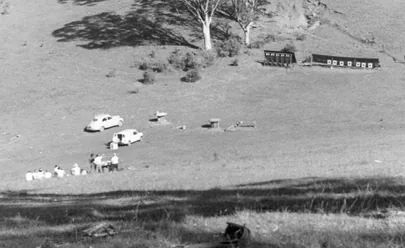
In 1963 the Liverpool club had two ranges. One was a hut in the Holsworthy Army base and the other was a range in a paddock just off Denham Court Road at Denham Court.
The hut at Holsworthy was used each Wednesday evening and incorporated a 25-metre range with a few fold-up tables as shooting benches. Targets were scaled-down versions of the 50-metre ISU (ISSF) target. Generally single-shot .22 pistols were used on this range: mainly .22LR Webley and Scotts, .22LR Drulovs, and a few .310 cadet actions converted to .22LR, fitted with orthopaedic grips and a set trigger. One or two Hammerli free pistols were just making an appearance.
The Denham Court range was extremely basic and situated in an open paddock. Car parking was usually at the top of a hill, with a walk down a reasonably steep slope to the range. Members with souped-up or newer cars blew a lot of smoke and chewed up grass getting from the bottom of the hill back to the top. A hint of rain or dew precluded trying the slope, and if it rained while cars were at the bottom it meant a quick exit or the risk of being stranded.
The Denham Court range consisted of one bank of five manually operated turning targets and provision for 10 targets for use at 25 or 50 metres. Backstops were steel-angled plates about two metres high, backed by the natural slope of a hill. Free Pistol from the 50-metre line could not be shot at the same time as a 25-metre match, as there was no dividing wall.
To shoot from 50 metres was not straightforward. It meant standing on the side of a hill and shooting across a dip, so depending on which target was being used the shooter could be firing either downhill or uphill. It was difficult to find a level spot, and small steps were cut into the hill for each competitor to provide a sort of level shooting platform. Some positions were better than others, and longer-term members seemed to “own” the better sites. The firing line for Rapidfire was at the bottom of the dip, so it was necessary to shoot uphill. There was no building on the range and the “benches” were wooden cable drums from the PMG, now Telstra. Being timber, the drums sometimes went missing in action — it was believed they were borrowed by locals for firewood.
Three matches, and the cost of centrefire
In the early sixties there were only three authorised matches: Free Pistol, Rapidfire and Centrefire. On the Denham Court range, Rapidfire pistols were mainly Hi-Standard in both .22 Long Rifle and .22 short, Star .22 short, Browning .22 Long Rifle, and the first .22 short Walther OSPs with the round, longer barrel and without compensation holes, which were just appearing.
Centrefire pistols were mainly S&W K38s, and these were not common because of the cost of reloading equipment and a general lack of knowledge of reloading and projectile casting. Projectiles were difficult, if not impossible, to purchase. That changed rapidly from the mid-sixties onwards as reloading and lead casting became better known, and equipment was purchased by small groups or teams of members to cut the cost and pool the knowledge. By the late sixties, commercially manufactured projectiles were readily available at reasonable cost — so somewhere around the place there is a heap of old casting, lubricating and sizing equipment.
When I first joined, prominent members I remember were Geoff and Brian Banyer, Don Irving, Norm Macaulay, Roy James, Doug Blades, Jim Munro, Gordon Dunning, Arthur Smith, Norm Baxter and his daughter Maureen. Geoff Banyer and Don Irving were firearm dealers, and Don Irving had represented the NSW state rapid fire team.
Until January 1964, to apply for a pistol licence an application had to be made to the local police sergeant or licensing officer. The application was knocked back as a matter of course, and it was then necessary to make an appeal before a magistrate. Providing the applicant was of good character, this long-winded process generally resulted in a licence being granted — but not always.
Building the range
From memory, funds for range construction came from a number of sources. Money was in the bank through good financial management since the inception of the club. An influx of new members over the previous few years, coupled with an increased joining fee, provided another source, and a levy was also placed on members.
A lot of materials used in the construction of the range were donated, as was almost all labour, with the exception of site excavation and backstop mound building. I seem to think Norm Baxter, who was a Contracts Manager with the Metropolitan Water Sewerage and Drainage Board, had a contact with the earthmoving company, which resulted in reduced rates.
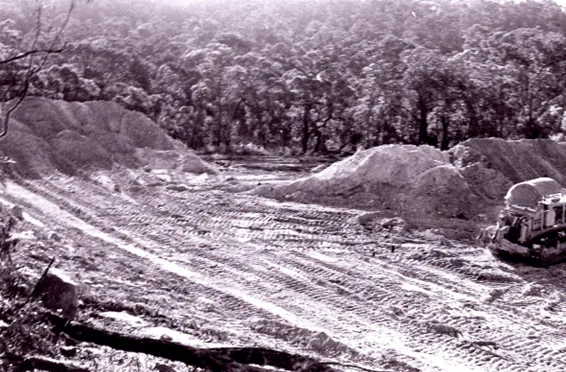
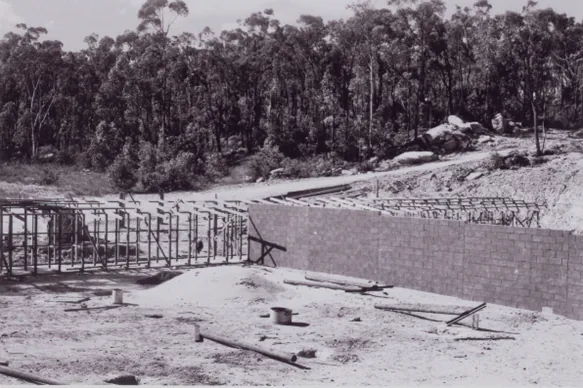
There were a host of volunteer contributors. Most members worked as labourers, but there were major contributions from members with particular skills. Roy Fraser, who had an engineering background, designed the baffles in accordance with correct engineering principles. Barry Dyer and Kevin Cox undertook most of the welding and fabrication of baffles and target frames. George Kysil was a builder, and it was his expertise and hard work that produced most of the building works. Members who attended most working bees over 12 months, both Saturdays and Sundays, were Norm Macaulay, Gordon Dunning, Peter and Bob Fraser, Roly Muscat, Merv and Percy Shoesmith, Doug Blades, Jim Munroe, Bryan MacGuren and me. There were others, but these are the names I recall.
Amateur powder monkeys
An interesting incident occurred while holes to insert the baffle supports were being dynamited. Initially a powder monkey from one of the mines was employed to carry out the blasting. He proved unreliable about attending when needed, and also appeared overly cautious. It was resolved to do the blasting ourselves.
A cautious start again showed little result in removing the sandstone, so it was decided to considerably increase the charges. Good and exciting results were soon achieved, with rock, dust and smoke shooting into the air and our amateur powder monkeys and the other workers cowering under cover wherever they could find it.
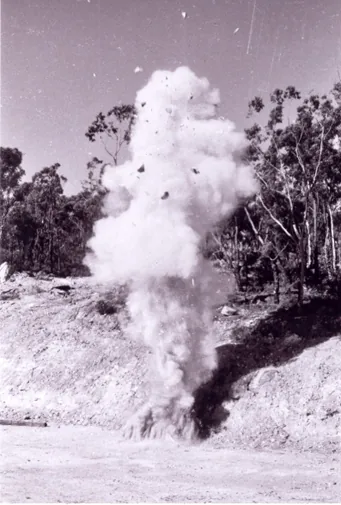
After several great successes, one set of charges appeared not to go off. Great consternation and fear were evident. The tamped-down sand had to be slowly and carefully removed by hand from holes two or three inches across and more than four feet down into solid rock. This took a lot of time, but when each hole had been cleared it became obvious the charges had detonated and the blast had dissipated in layers of sandstone without any obvious disturbance or above-ground noise.
Some weeks later the same situation occurred again and, knowing from previous experience there was nothing to worry about, the pneumatic drill was employed to clear the sand rather than spending hours doing it by hand. Instant panic resulted when some undetonated gelignite was drilled out of the hole. We quickly learned a lesson, and although the blasting was continued by us amateurs, it was with a lot more care and a healthy amount of fear.
The Badcoe trophy
Around the time the range was under construction, Camden Pistol Club, who had a range in a quarry near Camden, lost their range. They were a comparatively small club that could not find another site, so those who wished to continue shooting joined the Liverpool Club. Only a handful transferred and most dropped out fairly soon afterwards.
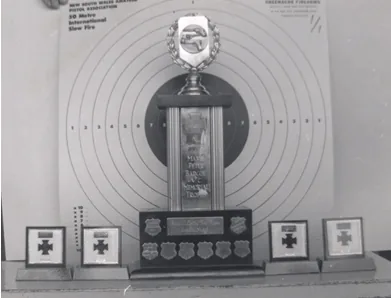
On completion of the range, it was decided to institute the Peter Badcoe VC Memorial Match which, at the time, was the first ever graded club teams match. This event, still conducted by the club, is one of the longest-running team matches in the country — it may even be the longest-running event of its kind. Initially the Badcoe trophy match was held in conjunction with the CMPC Centrefire and Ladies matches.
Combat, and then Service Pistol
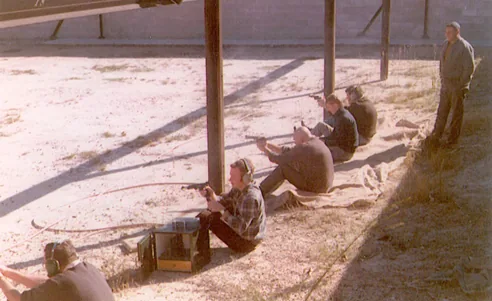
In the very late 1960s and early 1970s the combat pistol match became popular. For reasons political, even at that time, the name of the match was later changed to Service Pistol.
In the early 1970s my then wife Kathy, who had also been a member of Liverpool Club, transferred to Blacktown Pistol Club, as we had built a house in the lower Blue Mountains and the travel distance to the Liverpool range became prohibitive. Other than an occasional visit over the next couple of years, this ended my relationship with Liverpool Pistol Club.
— Richard Fenning, 2006
The Badcoe still runs every February
More than fifty years on, the centrefire teams match instituted when the Kentlyn range opened is still on the calendar.