
Home / Myths & facts
Setting the record straight
A great deal of what gets said publicly about firearms has very little to do with licensed target shooting. So rather than argue, here is the whole of it: exactly what the law requires of a sporting shooter in New South Wales, start to finish, with nothing left out.
Most people have never met a target shooter and have never been told what the sport actually involves. The detail turns out to be the answer to almost every question anyone has — which is why this page is mostly detail.
Nothing here is unique to CLDPC. It is the law that applies to every licensed pistol shooter in New South Wales, administered by the NSW Police Firearms Registry, and every one of our members has been through all of it. Check any of it against the Registry directly; we would rather you did.
The short version
Six things worth knowing before anything else
If you read nothing further, read these. Each one is a plain statement of how the sport actually works in this state.
Every pistol belongs to someone the police have licensed and inspected
Not registered once and forgotten — licensed, storage physically inspected by police, and required to keep qualifying year after year.
For the first six months you cannot acquire anything at all
A probationer shoots club pistols, on club premises, supervised. Only in the second six months can they be issued permits — at most two, of specified types — and the full licence comes no earlier than twelve months.
A licence has to be re-earned continuously
Six scored competitive matches every year, and continuing club membership. Stop competing and you stop qualifying to hold it.
The firearm lives in inspected storage, not in a drawer
Safe storage is a legislated standard checked by police, who issue an event number recording the inspection. Ammunition is stored separately.
Each individual firearm needs its own permit
Holding a licence does not let you buy anything. Every acquisition requires a separate Permit To Acquire, with the club and the police both signing off.
It is an Olympic sport, shot at paper, one-handed
The matches shot here are the matches shot at the Games, under the same international rules, by juniors and seventy-year-olds on the same firing line.
Getting licensed
Twelve months, minimum, before you can own a pistol
There is no route that is quicker, and no version of it you can do alone at home. A Category H licence is issued for one of two reasons in this state: employment, or target shooting as a member of an approved club.
Join an approved club
A Category H licence requires a genuine reason, and for a sporting shooter that reason is club membership. You cannot apply first and join later. The club has to be approved by the Firearms Registry and holds an approval number that appears on your paperwork.
Complete safety training
Before you handle a club pistol unsupervised you do a safe-handling course run at the club. Until then, and for as long as you want it, you shoot under the direct supervision of an experienced member.
Apply, and be checked
The application goes to the NSW Police Firearms Registry. They decide, not the club. The club's role is to confirm that you are a financial member and that what you have told the Registry about your shooting is true.
Six months with nothing of your own
A probationary licence holder cannot possess or use a pistol at all except on approved club premises, under the direct supervision of a full Category H holder. For the first six months there is nothing to acquire and no way to acquire it. You must also complete at least three competitive club shoots in that time, and pass the Pistol Safety Training Course.
Then at most two, of specified types
Only in the second six months, and only having passed that course, can a probationer be issued Permits To Acquire — a maximum of two, drawn from one centrefire, one rimfire of .22 or less, one air pistol and one black powder pistol. A centrefire and a rimfire may not be held at the same time. Another three competitive shoots are required across this half.
Then, and only then
Having held the probationary licence for its full twelve-month term and met every participation and training requirement, you become eligible to apply for a full Category H licence — and only then does the two-firearm limit and the restricted list of types come off.
Staying licensed
The requirement never stops
A pistol licence is not something you earn once. The genuine reason has to remain true for as long as you hold it, and it is measured.
Every Category H licence holder must be a member of at least one approved pistol club and must take part in a minimum number of club shooting activities in each compliance period — of which at least six must be competitive matches, each with a score recorded against your name. Clubs keep those records and the Registry can ask for them.
That single requirement does more work than most people realise. A licence here is not a document that sits in a drawer: it belongs to somebody who turns up, shoots in front of other people, and has a scorecard to show for it six times a year, every year. Somebody who stops doing that stops qualifying.
Where the pistol lives
Inspected storage, and a permit for every single firearm
The safe comes first
Safe storage is a legislated standard, not a suggestion, and it is checked. A shooter arranges a safe storage inspection through their local police station, and the police issue an event number recording that it happened. Ammunition is stored separately from the firearm.
That event number is then required later — you cannot complete the paperwork to acquire a handgun without either it or a statutory declaration in its place.
A permit for each acquisition
Owning a licence does not let you buy a pistol. Each individual firearm requires its own Permit To Acquire, applied for through a Service NSW account with identity verification, the club’s approval number, and the storage event number.
The Registry then emails the club secretary, who must separately certify that the applicant is a current financial member, that their safe storage is adequate, and that their stated shooting activity is accurate.
Three independent parties have to agree before one pistol changes hands: the police who inspected the storage, the club that knows whether the person actually shoots, and the Firearms Registry that issues the permit. No single one of them can wave it through.
On the day
Nothing happens casually
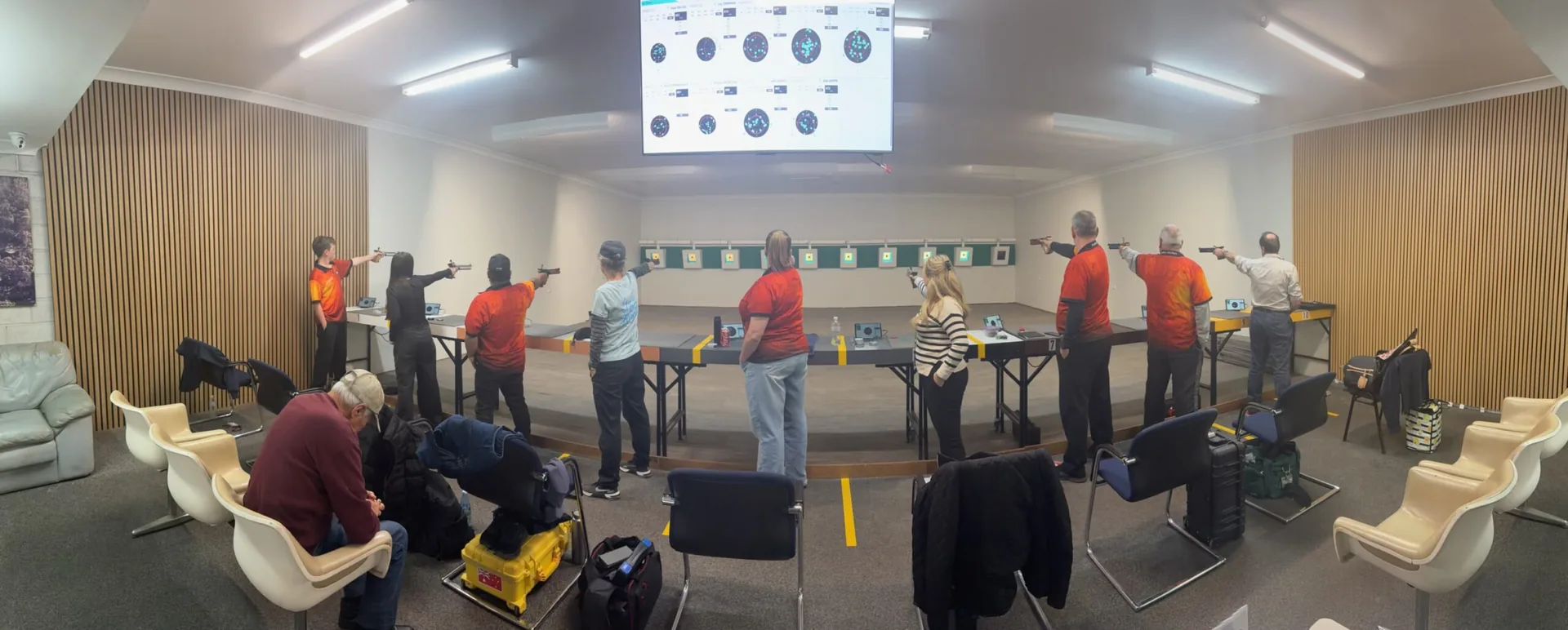
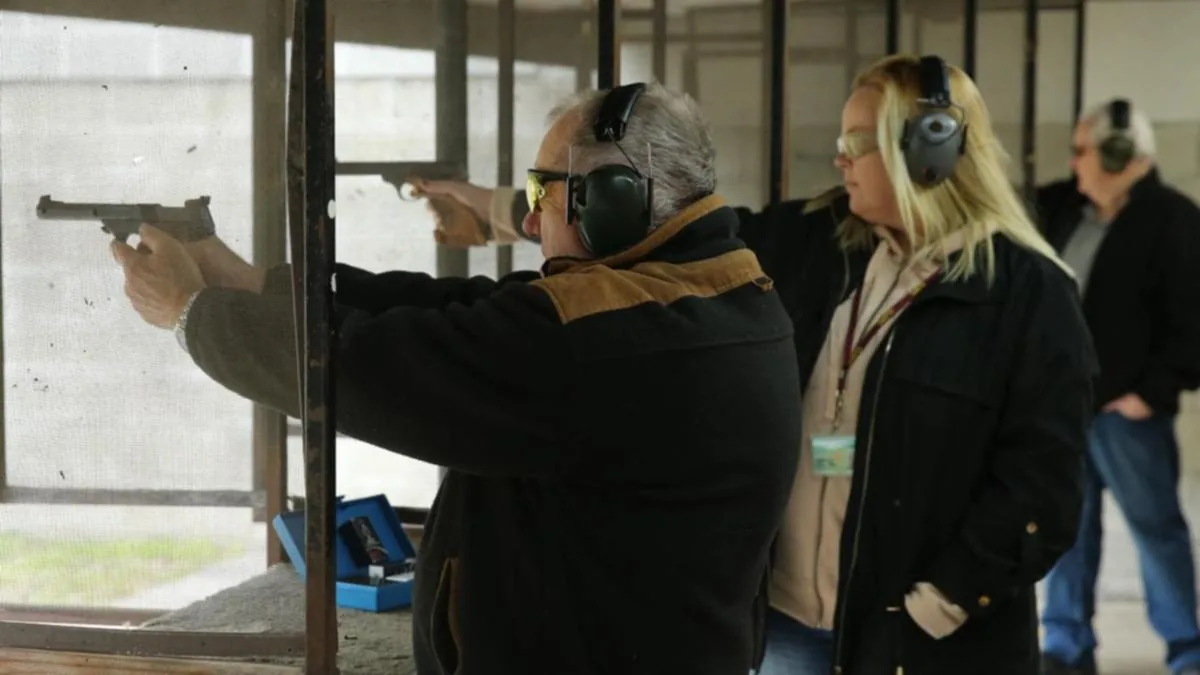
Every session runs under range commands given by a range officer, who has the authority to stop the line at any moment and whose instruction is final. Firearms stay cased until the shooter is on the firing point, and are unloaded and cased again before anyone leaves it.
Shooting only happens on a marked firing line, at paper targets, in one direction, on a range built and approved for it. Nobody is left to work it out for themselves — newcomers are supervised one to one, and experienced members are the first to say something if a habit slips.
The culture that produces is the thing visitors comment on most: it is quieter, slower and more orderly than almost anyone expects.
The sport itself
A broad sport, and one Australia is genuinely good at
Target pistol shooting is not one activity but a family of them, and every branch is shot at paper or steel, on an approved range, under the same licensing regime described above.
The ISSF programme is the Olympic one — air pistol, rapid fire, centrefire, 25m, standard and 50m free pistol — and it is what CLDPC is built around. Beyond it sit Service Pistol and WA1500, both shot at longer distances from barricades and positions; metallic silhouette, where the targets are steel animal cut-outs knocked down at ranges out to 100 metres; and cowboy action, shot with single-action revolvers of nineteenth-century pattern by competitors in period dress.
They look nothing like one another. What they share is the thing that matters: a marked firing line, one direction, a range officer with absolute authority, and a licensing system that took every competitor a year to satisfy before they could own the firearm in their hand.
Australia punches well above its weight internationally. For a country with a small licensed shooting population, Australians have taken world titles and international podiums across several of these disciplines, including in WA1500 — and target shooting remains one of the sports in which an Australian can genuinely contend at world level without a professional infrastructure behind them.
Part of the reason is the age profile. This is a sport where experience compounds and where a competitor’s best years can arrive in their forties and fifties, so careers are long and depth is built slowly rather than bought.
One of ours
Australia’s first Olympic shooting medal was won by a member of this club
Pattie Dench took up pistol shooting at 42, in 1974, with the Campbelltown Liverpool Pistol Club. Ten years later she stood on the podium in Los Angeles.
At the 1984 Games she won bronze in the inaugural women’s sport pistol event, shooting 583 out of 600 and then winning a shoot-off to take the medal. She was 52 — the oldest medallist of those Games in any sport — and it was the first Olympic shooting medal Australia had ever won. She also took three World Championship silver medals, in 1978 and 1979, and the 25m range at the Sydney International Shooting Centre carries her name.
It is worth sitting with what that means for anyone reading this page and wondering whether they are the right sort of person for this sport, or whether they have left it too late. She started at 42, at this club, and beat the world.
The injury numbers
Around 61,000 Australians a year are hospitalised playing sport. Shooting is not on the list.
The Australian Institute of Health and Welfare counts sports injuries serious enough to put somebody in a hospital bed. It is the national figure, and it is not small.
~7,200
Cycling — the single largest cause, about 12% of all sports injury hospitalisations.
~5,400
Soccer, and much the same again for Australian rules football.
18%
The share taken by the football codes together — around 10,900 hospitalisations a year.
Not listed
Target shooting does not appear in the analysis at all.
Measured against participation rather than raw numbers the gap is starker still: rugby runs at roughly 1,500 hospitalisations per 100,000 participants. Somewhere in a hospital this morning is a queue of people who hurt themselves doing something completely ordinary on a Saturday.
There is no mystery to shooting’s absence from that list. Nobody runs. Nobody collides with anybody. Nothing is thrown, kicked or swung, and there is no opponent within reach of you at any point.
A competitor stands still on a marked line and concentrates, which is the entire physical demand of the sport. The most strenuous thing most members do on a Saturday is carry a range bag from the car.
And if anything is wrong — anything at all, spotted by anybody present — one call stops the whole line instantly, and it stays stopped until the matter is sorted out. No other sport gives every single participant an unquestioned right to halt play.
Why the record is what it is
The restrictions are the reason it is so safe
Nothing about this sport is left to good intentions. Every element described on this page is a control, and they stack.
Who
Police-assessed, club-vouched, twelve months on probation, and re-qualifying through six scored matches a year for as long as they hold the licence.
What
A permit for each individual firearm, tied to the discipline it is used for. Target pistols are specialised competition equipment, built for one job.
Where
Approved ranges only, on a marked firing line, in one direction, under range commands — then unloaded, cased, and into inspected storage at home.
Those controls are why a shooting range is one of the most orderly places you can spend a Saturday morning, and why the people you will meet on one are the first to insist on them. A licensed sporting shooter has more to lose from a lapse than anybody.
Where this comes from
Check every word of it yourself
None of this is our interpretation. It is what the NSW Police Firearms Registry publishes, and the Registry is the authority — not us, and not anybody quoted in a newspaper. If anything here has fallen out of date, the Registry is right and we are wrong.
- Probationary Pistol Licence fact sheet — the six-month restriction, the two permits, and the pistol types
- Sport / Target Shooting genuine reason fact sheet — what the licence is for and what it authorises
- Participation requirements for club members — the shooting you must do each year to keep the licence
- NSW Police firearms licensing — the whole of it, from the source
- AIHW, Sports injury in Australia — the hospitalisation figures quoted above, and the list shooting is absent from
Come and look for yourself
The best answer to a rumour is an afternoon at the range
Anyone is welcome to visit and watch, with no licence and no commitment. Ask us anything you like while you are here.